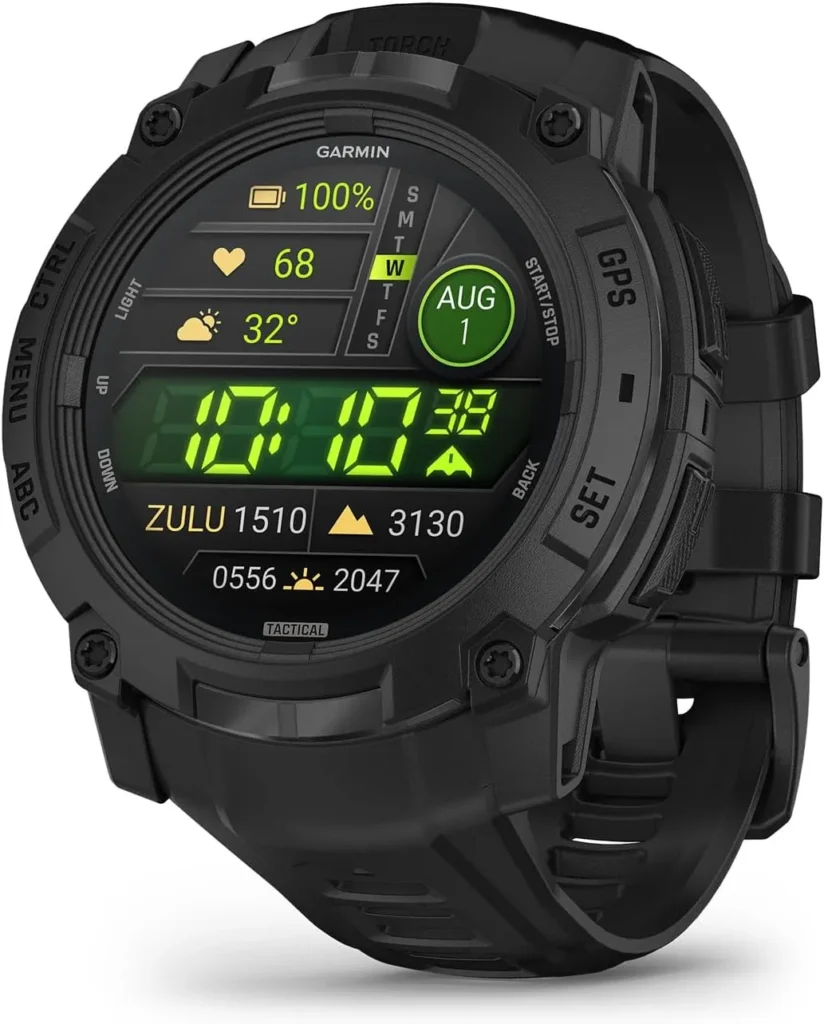
The Garmin Instinct 3 AMOLED takes the rugged, no-nonsense formula of the Instinct line and pairs it with a bright color display. This review looks at the display, GPS and navigation, fitness and health tracking, battery life and durability of the 45 mm model, and explains who it may suit and who might prefer something else.

Garmin Instinct 3 AMOLED 45 mm: quick specs
The table below summarizes the main specifications of the 45 mm model, based on retailer listings that reproduce Garmin’s published data.
| Feature | Garmin Instinct 3 AMOLED 45 mm |
|---|---|
| Display | 1.2-inch (30 mm) AMOLED, 390 × 390 pixels, always-on capable |
| Case size and weight | 45 × 45 × 14.9 mm; about 53 g |
| Materials | Fiber-reinforced polymer case, metal-reinforced bezel, chemically strengthened glass, silicone strap |
| Durability | 10 ATM water rating; MIL-STD-810 thermal and shock resistance |
| Battery (smartwatch mode) | Up to 18 days (7 days with the display always on) |
| Battery (GPS) | Up to 32 hours GPS-only; up to 25 hours with all satellite systems |
| Positioning | Multi-band GPS with SatIQ, GLONASS, Galileo |
| Sensors | Wrist heart rate, 3-axis compass, barometric altimeter, blood oxygen |
| Extras | Built-in LED flashlight, 4 GB storage, ANT+, QuickFit 22 mm bands |
| Wrist fit | 137–204 mm circumference |
Sources: CycleGear (n.d.); Adorama (n.d.); Android Central (n.d.); Best Buy listing for the Garmin Instinct 3 45 mm AMOLED.
AMOLED display: the biggest change for the Instinct line
Earlier Instinct watches used a low-power, memory-in-pixel screen that is readable in sunlight but visually plain. The Instinct 3 AMOLED replaces it with a 1.2-inch full-color panel on the 45 mm case and 1.3 inches on the 50 mm case, at 390 × 390 and 416 × 416 pixels respectively (Adorama, n.d.). In practice, that means sharper maps-style graphics, richer watch faces and easier reading of data fields during a workout.
The trade-off is power. Garmin’s figures show that keeping the screen always on cuts smartwatch-mode battery life on the 45 mm model from up to 18 days to about 7 days (CycleGear, n.d.). Reviewers have noted that the brighter screen is a clear visual upgrade, while also pointing to battery as the main compromise (GearJunkie, n.d.; Richardson, 2025).

See the current price and colors. Prices and availability change often, so the latest offer is best checked directly on Amazon.
Check price on AmazonAffiliate Disclosure: This website contains affiliate links. We may earn a commission when you purchase products through links on our site, at no additional cost to you. As an Amazon Associate I earn from qualifying purchases.
Learn more
- Make a bold statement with this rugged GPS smartwatch, featuring a vibrant 1.2” AMOLED display and up to 18 days of batt…
- Engineered with a supertough 45 mm fiber-reinforced polymer case and metal-reinforced bezel
- Built-in LED flashlight with variable intensities and strobe modes gives you greater visibility in the outdoors and prov…
Rugged design: built to take a beating
Durability remains the identity of the Instinct line. The 45 mm model uses a fiber-reinforced polymer case with a metal-reinforced bezel, a chemically strengthened glass lens and a silicone strap (Android Central, n.d.; Adorama, n.d.). Garmin states that it is engineered to MIL-STD-810 standards for thermal and shock resistance, and it carries a 10 ATM water rating, which retailers describe as suitable for swimming and water sports (Sam’s Club, n.d.). One independent review lists an operating temperature range from −20 °C to 60 °C (Digital Citizen, n.d.).
At about 53 g, the watch is light for a rugged model, which also helps keep the sensor steady against the wrist during exercise (Android Central, n.d.; Live Science, n.d.). The built-in LED flashlight is a practical feature for early-morning runs, camping or walking a dog after dark, and reviewers have singled it out as a useful extra (T3, n.d.; GearJunkie, n.d.). Band swaps are simple because the watch accepts 22 mm QuickFit bands on the 45 mm size (Adorama, n.d.).
GPS and navigation features
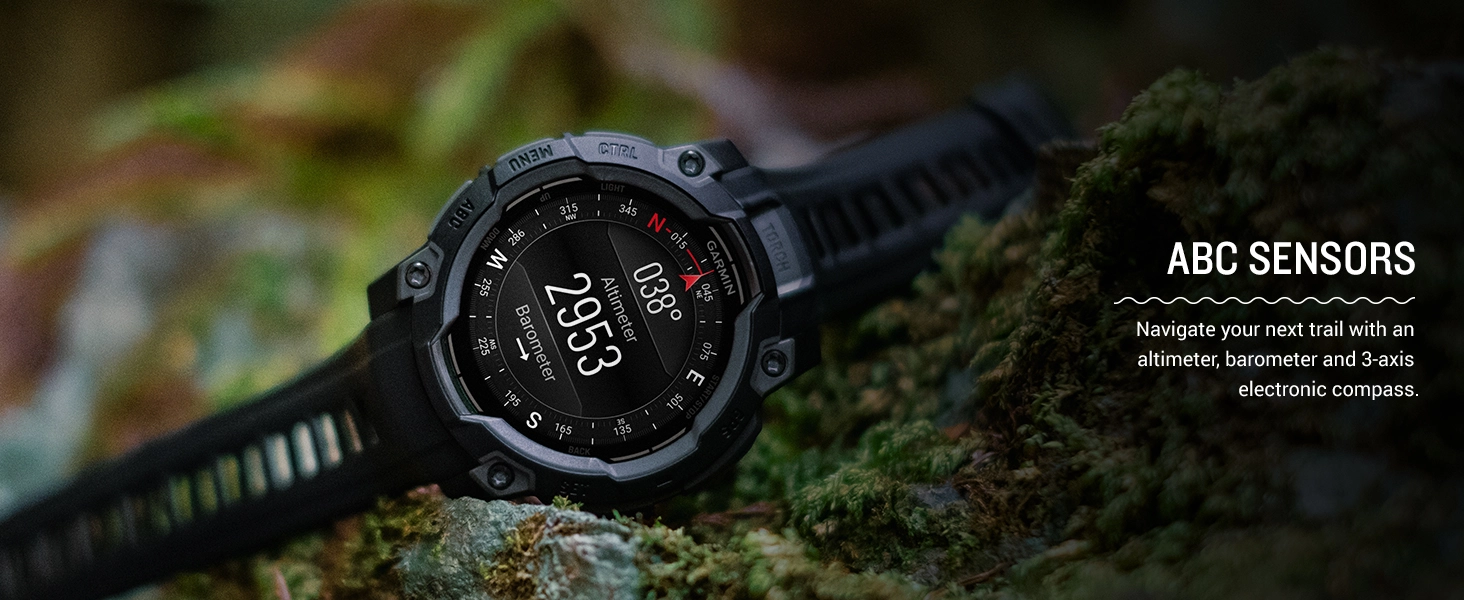
The Instinct 3 uses multi-band GPS with Garmin’s SatIQ technology, which is designed to improve positioning while managing battery use (Best Buy, n.d.). Specification sheets also list GLONASS and Galileo support, so the watch can use several satellite systems (Aspen Solutions, n.d.). A 3-axis compass and a barometric altimeter complete the outdoor sensor set (Best Buy, n.d.).
In independent testing, OutdoorGearLab (Richardson, 2025) compared GPS and heart rate output with a chest-strap benchmark on a fixed 2.80-mile course and scored the watch 9.0 out of 10 in its accuracy category. The reviewer described it as reliable enough for casual fitness tracking and endurance efforts, while noting that it was not precise enough for high-intensity training zones. Navigation is on the simpler side: GearJunkie (n.d.) describes it as breadcrumb navigation, so runners and hikers who expect detailed topographic mapping on the wrist may want a more advanced watch.
Fitness and health tracking
The watch records the standard Garmin set of daily and workout metrics. The table summarizes what published specifications and reviews list for this model.
| Feature | Listed? | Notes |
|---|---|---|
| Wrist-based heart rate | Yes | Continuous and during activities; accuracy varies with effort level. |
| Heart rate variability (HRV) | Yes | Used for readiness and recovery insights. |
| VO2 max estimate | Yes | An estimate, not a laboratory measurement. |
| Sleep tracking | Yes | Sleep score and insights are listed. |
| Blood oxygen | Yes | Wellness information only. |
| Multisport profiles | Yes | Includes running, swimming and golf, among others. |
| Irregular heart rhythm warnings | Not listed | One specification database states they are not included. |
| Wireless charging | No | Charges with the supplied cable. |
Sources: T3 (n.d.); Dateks (n.d.); GPS Central (n.d.); TurboVS (n.d.).
How accurate is wrist-based heart rate?
No optical wrist sensor is perfect. Bent et al. (2020) reported that the accuracy of wearable optical heart rate sensors varied across devices and activity types, with larger errors during activity than at rest. Shcherbina et al. (2017) found that heart rate readings from several wrist-worn devices stayed within roughly 5% of electrocardiogram values on average, whereas energy-expenditure (calorie) estimates showed much larger errors. For that reason, calories displayed by this or any similar watch are best treated as rough estimates.
Reviews of the Instinct 3 are consistent with those findings. Android Central and Richardson (2025) both suggest that steady-state exercise is handled well, and Richardson recommends a chest strap for athletes who need precise zone data. Some owners also report occasional heart rate, sleep and connectivity issues in retailer feedback (Competitive Cyclist, n.d.).
Sleep tracking and daily activity
Chinoy et al. (2021) evaluated seven consumer sleep trackers against polysomnography and found that they detected sleep well but were less accurate at identifying wakefulness and individual sleep stages. That study did not include the Instinct 3, but the general lesson applies: sleep scores are useful for spotting trends, not for diagnosing sleep problems. A systematic review of reviews by Ferguson et al. (2022) also found that wearable activity trackers were associated with increases in physical activity among adults, which supports the idea that a watch like this can be a motivational tool.
Battery life: strong for an AMOLED, shorter than solar rivals
Garmin’s published figures for the 45 mm model are shown below. The 50 mm version is reported to last about 25–30% longer, with up to 24 days in smartwatch mode (CycleGear, n.d.; The5kRunner, n.d.).
| Mode (45 mm) | Manufacturer-listed battery life |
|---|---|
| Smartwatch mode | Up to 18 days |
| Smartwatch, always-on display | Up to 7 days |
| Battery saver watch mode | Up to 24 days |
| GPS only | Up to 32 hours |
| All satellite systems | Up to 25 hours |
Source: CycleGear (n.d.). Real-world results depend on display settings, notifications and workout habits.
Battery life was the weakest category in OutdoorGearLab’s scoring, at 5.2 out of 10, and GearJunkie (n.d.) notes it is not the best on the market (Richardson, 2025). That judgment is relative to solar and memory-display rivals, since 18 days between charges is still long compared with most AMOLED smartwatches.
Affiliate Disclosure: This website contains affiliate links. We may earn a commission when you purchase products through links on our site, at no additional cost to you. As an Amazon Associate I earn from qualifying purchases.
Learn more


Garmin Instinct 3 AMOLED: pros and cons
Pros
- Bright, sharp AMOLED display on a rugged watch
- MIL-STD-810 thermal and shock resistance and 10 ATM water rating
- Light for its class, at about 53 g (45 mm)
- Multi-band GPS with SatIQ and several satellite systems
- Up to 18 days of battery in smartwatch mode
- Built-in LED flashlight, compass and barometric altimeter
- HRV, VO2 max estimate, sleep and recovery insights
Cons
- Always-on display cuts battery life to about 7 days
- Simple breadcrumb navigation rather than detailed maps
- No solar charging on the AMOLED version
- No wireless charging
- Wrist heart rate loses precision at high intensity
- Irregular rhythm warnings are not listed in published specs
Sources: GearJunkie (n.d.); Richardson (2025); TurboVS (n.d.); CycleGear (n.d.).
AMOLED vs Solar, and 45 mm vs 50 mm
The Instinct 3 comes in AMOLED and Solar versions, and in two case sizes. Android Central (n.d.) compares them as follows.
| Feature | Instinct 3 AMOLED | Instinct 3 Solar |
|---|---|---|
| Display | Full-color AMOLED (1.2″ or 1.3″) | Memory-in-pixel, two-window (0.9″ or 1.1″) |
| Glass | Chemically strengthened | Power Glass (solar) |
| Weight (45 mm / 50 mm) | 53 g / 59 g | 52 g / 58 g |
| Memory | 4 GB | 128 MB |
| Solar charging | No | Yes |
| Durability | 10 ATM and MIL-STD-810 on both | |
In short, the 45 mm AMOLED suits smaller wrists and a lighter feel, the 50 mm adds a bigger screen and longer battery, and the Solar version is aimed at people who value near-endless battery over screen quality (Android Central, n.d.; CycleGear, n.d.).
Who the Garmin Instinct 3 AMOLED may suit
It may be a good fit for
Hikers, campers, trail runners and people with physical jobs often value a watch that tolerates knocks, water and temperature changes. Everyday users who want a readable color screen without giving up Garmin’s tracking ecosystem may also find it appealing, as may people who want multi-week charging cycles rather than daily charging.
Other options may suit better if
Runners focused on structured training may want a model with more advanced training tools and detailed mapping, and anyone who needs the longest possible battery may prefer a solar model. Readers comparing several watches can review MoweSport’s best GPS watches for runners guide.
Ready to compare sizes and bands? Current pricing, colors and customer reviews are listed on Amazon.
View on AmazonFrequently asked questions
Does the Garmin Instinct 3 AMOLED have GPS?
Yes. It uses multi-band GPS with SatIQ and also supports GLONASS and Galileo (Best Buy, n.d.; Aspen Solutions, n.d.).
How long does the battery last?
The 45 mm model is listed at up to 18 days in smartwatch mode, about 7 days with the display always on, and up to 32 hours in GPS-only mode. The 50 mm model lasts longer (CycleGear, n.d.).
Is it waterproof?
It has a 10 ATM water rating, which retailers describe as suitable for swimming and water sports. Owners should check the manual for other water activities (Sam’s Club, n.d.).
Is it accurate enough for training?
Independent testing found accuracy adequate for casual fitness and endurance efforts, but not precise enough for high-intensity heart rate zones. A chest strap is recommended for that purpose (Richardson, 2025).
Does it replace medical advice or devices?
No. It is a consumer fitness device. Questions about symptoms, heart health or exercise suitability should go to a physician or qualified professional.
Verdict
The Garmin Instinct 3 AMOLED combines a bright color screen, a tough build and respectable battery life in a lightweight package. According to published reviews, its main compromises are shorter battery life than solar rivals when the display stays on, simple navigation and wrist-based heart rate that is best suited to steady efforts (GearJunkie, n.d.; Richardson, 2025). For outdoor-minded users who want a durable, readable and Garmin-compatible watch, it is a credible option; for those who prioritize maximum battery or advanced mapping, comparing alternatives is worthwhile.
Affiliate disclosure: MoweSport is a participant in the Amazon Services LLC Associates Program. As an Amazon Associate, MoweSport earns from qualifying purchases at no extra cost to readers. Product details and prices may change; always verify on the retailer page.