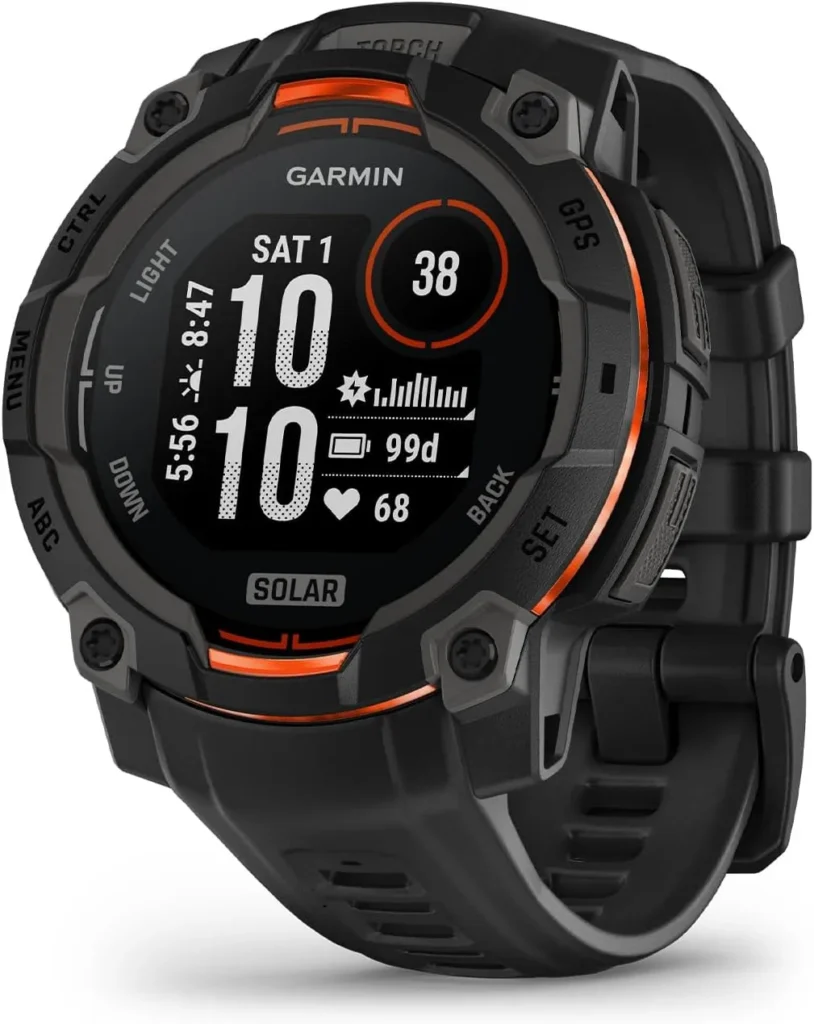
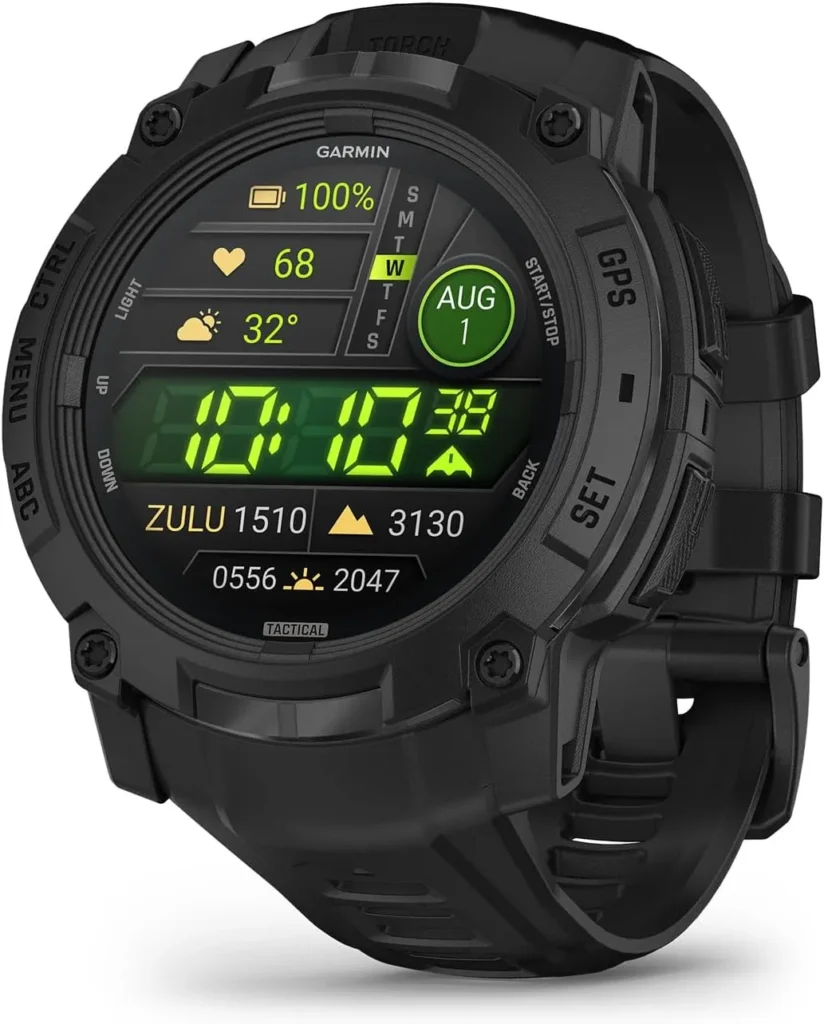
A rugged GPS smartwatch with the first color display in the Instinct line
Two case sizes, a 100-meter water rating, a built-in flashlight and a battery rated up to 24 days. This review explains where the Instinct 3 AMOLED shines and where it falls short.
Check the current price- 1.2-inch or 1.3-inch AMOLED
- 10 ATM water rating
- MIL-STD-810 construction
- Up to 24 days (50 mm)
- Built-in LED flashlight
Garmin spent years building the Instinct line around monochrome screens and very long battery life. The Instinct 3 AMOLED keeps the rugged body but swaps in a bright color display, adds a metal-reinforced bezel and brings multi-band GPS to both sizes. It also arrives with trade-offs that independent reviewers flagged quickly, including no touchscreen and no offline maps.
Disclosure: MoweSport participates in affiliate programs and may earn a commission if a reader buys through a link on this page, at no extra cost to the reader. Commissions do not change how the sources below are summarized.
How this review was built. MoweSport did not run its own lab tests on this watch. The article summarizes Garmin’s published specifications and the hands-on testing of an independent reviewer who wore the watch in workouts. The main sources date from early 2025, so price, firmware and software behavior may have changed. Check the current Garmin listing before buying.
Medical and safety notice. This article is educational and is not medical advice. The author is not a physician. A smartwatch estimates heart rate, sleep and stress from sensors on the wrist, and these readings are not a diagnosis. Safety features such as incident detection depend on a paired phone and a signal, so they do not replace emergency planning.
Anyone with a health condition, a heart concern, or a plan to start a demanding training program should consult a physician before relying on the data. Seek medical care for symptoms such as chest discomfort, dizziness or fainting, regardless of what a watch shows.
Pick a Size: 45 mm vs 50 mm
The Instinct 3 AMOLED comes in two cases, and the difference goes beyond looks. The larger watch carries a bigger battery and screen, which Garmin reflects in its battery claims (Adorama, n.d.). Use the buttons to switch the table between sizes.
| Specification | Value |
|---|---|
| Display | 1.2-inch AMOLED, 390 × 390 pixels1.3-inch AMOLED, 416 × 416 pixels |
| Case size | 45 × 45 × 14.9 mm50 × 50 × 14.4 mm |
| Weight | About 52–53 gAbout 59 g |
| Band | 22 mm QuickFit26 mm QuickFit |
| Smartwatch mode | Up to 18 days (7 days always-on display)Up to 24 days (9 days always-on display) |
| Battery saver watch mode | Up to 24 daysUp to 30 days |
| Max battery GPS mode | Up to 68 hoursUp to 86 hours |
| Launch price (US) | $449$499 |
Sources: Adorama (n.d.) for battery and display figures; CycleGear (n.d.) for dimensions and weight; Maker (2025) for launch prices. Retail prices have varied since launch.
What Changed Compared With the Instinct 2
The headline change is the display, but the Instinct 3 also adds several features that the Instinct 2 lacked. The table groups them by purpose. Items marked “AMOLED only” are not available on the monochrome Solar models, according to the reviewer’s list of differences (Maker, 2025).
| Area | What was added | Source |
|---|---|---|
| Display | AMOLED option with larger screens; the small secondary display window is dropped on AMOLED models | Maker (2025) |
| Durability | Metal-reinforced bezel on a fiber-reinforced polymer case, MIL-STD-810 rating, water rating to 100 meters | Garmin Ltd. (2025) |
| Positioning | Multi-band (dual-frequency) GNSS and SatIQ on every model | Maker (2025) |
| Training tools | Training Load Focus, Training Load Ratio and automatic multisport transitions | Maker (2025) |
| Strength training | Muscle Map and workout animations (AMOLED only) | Maker (2025) |
| Sleep | Nap detection and Sleep Coach | Maker (2025) |
| Everyday use | Garmin Pay on all models, large font mode (AMOLED only), Garmin Messenger compatibility, built-in flashlight | Maker (2025) |


Design, Display and Controls
The Instinct 3 keeps the look that gave the line its identity: a round case in fiber-reinforced polymer, now with a metal ring reinforcing the bezel, a scratch-resistant display and a 10 ATM water rating (Garmin Ltd., 2025). The AMOLED panel is always-on and bright, and the reviewer rates its colors and brightness well above the monochrome panel used on the Solar models (Maker, 2025).
Navigation is the surprise. Neither Instinct 3 model has a touchscreen, an unusual choice for an AMOLED watch, so everything runs through the familiar five-button layout, with three buttons on the left and two on the right. The reviewer needed a few days to adjust but argues that physical buttons suit an outdoor watch because they work in all weather (Maker, 2025).
The flashlight is the feature most likely to be used daily. It combines a white LED with four brightness levels and a red LED, and a double-tap of the upper-left button turns it on. It can also blink in a pattern while running, including one tied to cadence (Maker, 2025). The watch also supports contactless payments through Garmin Pay, and notifications from a paired phone, although an iPhone user can dismiss texts but not reply to them, while an Android user can reply (Maker, 2025).
Battery Life: Claims vs Reviewer Estimates
Garmin rates the AMOLED models for up to 24 days in smartwatch mode (Garmin Ltd., 2025). That figure applies to the 50 mm watch with the always-on display off. Choose a mode below to compare the two sizes against the larger watch.
Manufacturer ratings as listed by Adorama (n.d.). Bar lengths compare the two sizes within one mode; units differ between days and hours.
Claims and daily use rarely match. The reviewer reported battery estimates of roughly 35 to 45 hours for the AMOLED model during runs and rides with SatIQ and wrist heart rate enabled, and his GPS-only estimates for the AMOLED watch ranged from about 41 hours on a 12-hour mountain hike to 58 hours on a three-hour road ride (Maker, 2025). Those numbers sit below the 68-hour and 86-hour ratings, which apply to a dedicated low-power GPS mode. The practical lesson is that settings matter as much as case size: SatIQ, always-on display and wrist heart rate all draw power.
Performance: GPS, Heart Rate and Training Tools
On positioning, the reviewer found the Instinct 3 impressive. Its SatIQ setting uses multi-band GPS only when conditions demand it (trees, buildings, cliffs) and lowers power use the rest of the time, and even the GPS-only configuration produced tracks close to those from multi-band rivals on most outings (Maker, 2025). Heart rate is a more mixed story. The watch uses Garmin’s fourth-generation optical sensor rather than the newer fifth-generation unit, so it does not offer ECG or skin temperature, and it made more errors than a fifth-generation Fenix 8 during a cold-weather interval run and on a rough trail run (Maker, 2025).
| Area | Finding | What it means for buyers |
|---|---|---|
| GPS accuracy | Close agreement with multi-band rivals in SatIQ and, most of the time, in GPS-only mode | Reliable tracks without paying a large battery penalty |
| Wrist heart rate | Good in steady efforts; weaker than the newer sensor in some cold or rough-terrain sessions | Athletes who need maximum accuracy can pair an external strap |
| Health sensors | No ECG or skin temperature, features limited to the newer sensor | Not a fit for buyers who want those readings |
| Training Readiness | Combines sleep, recovery time, HRV status, acute load, sleep history and stress history; about 30 days of data needed to settle | Expect the score to become more useful after a month of wear |
| Sleep tracking | Sleep and wake times recorded correctly; the reviewer does not rely on sleep-stage detail | Treat stage data as an estimate, not a measurement |
All findings: Maker (2025). One reviewer’s testing, not a controlled study.
The software side is deep. The reviewer lists daily suggested workouts, structured workouts from Garmin or third-party platforms, HRV Status, Acute Load and a long sport list that includes strength, cardio, HIIT, yoga and Pilates alongside running, cycling, swimming and many outdoor activities (Maker, 2025). For general health goals, the World Health Organization advises adults to do 150 to 300 minutes of moderate aerobic activity per week, or equivalent vigorous activity, plus muscle-strengthening activity on at least two days (Bull et al., 2020). A watch can log those sessions, but the targets themselves should come from a health professional.
Navigation: The Missing Maps
This is where the reviewer is least forgiving. The Instinct 3 follows loaded routes with breadcrumb-style navigation, meaning a line on a blank screen, with turn alerts and an off-course warning. It has no offline maps and no ClimbPro, and a new city-points list shows only larger towns (Maker, 2025). The reviewer says the lack of maps became obvious at complex trail junctions and near cliffs, and he called it the biggest disappointment of the watch, since several rivals offered offline maps at lower prices when the Instinct 3 launched (Maker, 2025). Buyers who navigate with a phone or paper map may not care, but hikers who rely on the watch should weigh this carefully.
Who Is the Instinct 3 AMOLED For?
Select a profile to see how the findings above apply.
Hiker: a durable case, a flashlight with a red mode and strong GPS accuracy are real advantages, and route navigation works. The missing offline maps are the main drawback on unfamiliar or complicated trails (Maker, 2025).
Runner: SatIQ keeps tracks accurate while saving power, and the training tools include Training Readiness and Acute Load. Runners who want the best wrist heart rate in tough conditions may prefer an external strap or a watch with the newer sensor (Maker, 2025).
Gym and strength: the AMOLED model adds Muscle Map and workout animations for strength sessions, and strength, HIIT, yoga and Pilates profiles are available. The Solar models do not get the two strength-specific features (Maker, 2025).
Everyday wear: Garmin Pay, notifications and a large-font mode make daily use easier, but there is no touchscreen and no Wi-Fi, so syncing runs over Bluetooth to the Garmin Connect app (Maker, 2025). The 50 mm case weighs about 59 g (CycleGear, n.d.), so wrist size and comfort are worth checking, especially for overnight sleep tracking.