A set of resistance bands takes up less room than a pair of sneakers, yet it can cover most of the strength work a home routine needs. The hard part is choosing among loop bands, tube bands with handles, flat bands and fabric hip bands, each with its own color-coded levels that differ from brand to brand. This guide explains what the research says about elastic resistance, how the main band types compare, and what to check before buying.
Disclosure: MoweSport participates in affiliate programs. If a reader buys through a link on this page, the site may earn a commission at no extra cost to the reader. Commissions do not change the research summaries below.
Medical and safety notice. This article is educational and is not medical advice. The author is not a physician. Exercise type, intensity and frequency must be individualized to each person’s health, fitness level and medical history.
Anyone with a health condition, an injury, pregnancy, or a long break from exercise should seek medical evaluation and professional supervision (for example, a physician or a licensed physical therapist) before using any resistance band. Stop exercising and seek care if pain, dizziness, chest discomfort or other worrying symptoms appear. Nothing here promises specific results.
Key takeaways
- A 2019 systematic review and meta-analysis found no superiority of conventional devices over elastic devices for upper- or lower-limb strength, with similar gains across diverse protocols (Lopes et al., 2019).
- The World Health Organization recommends muscle-strengthening activity on at least two days per week for adults, involving all major muscle groups (Bull et al., 2020).
- Color labels are not a universal scale. Laboratory testing of Thera-Band products found that manufacturer reference values were overestimates (Uchida et al., 2016), so a “heavy” band from one brand can feel different from another.
- Lighter loads can still produce similar muscle growth when sets are taken to momentary failure, although heavier loads showed an edge for maximal strength (Schoenfeld et al., 2017).
Why Resistance Bands Work for Home Training
Elastic resistance behaves differently from a dumbbell. A free weight pulls with the same force at every point of a movement, while a band stretches and pulls harder the farther it is extended. Research on Thera-Band products describes this spring-like behavior: tension rises as elongation increases (Uchida et al., 2016). In practice, this means bands feel easiest at the start of a repetition and hardest at the end.
The key question for home exercisers is whether that different feel translates into different results. Lopes et al. (2019) pooled eight studies comparing elastic devices (tubes and Thera-Bands) with conventional devices (weight machines and dumbbells). The meta-analysis found no difference between the methods for upper-limb strength (standardized mean difference = −0.011) or lower-limb strength (standardized mean difference = 0.09), and the authors concluded that elastic resistance training can promote strength gains similar to conventional training. A caveat matters here: all included studies enrolled participants who already had a habit of strength training, so the findings may not apply equally to complete beginners (Lopes et al., 2019).
Loading is the second piece. Bands usually offer lighter absolute loads than a loaded barbell, which raises the question of whether light resistance can build muscle. Schoenfeld et al. (2017) reviewed trials comparing low-load training (60% of one-repetition maximum or less) with high-load training, all performed to momentary muscular failure. Muscle growth measures were similar between conditions, while gains in one-repetition-maximum strength were greater with heavier loads. The reviewers’ conclusion leaves room for bands in a home program, with the honest limitation that maximal strength may favor heavier resistance.
| Question | Finding | Source |
|---|---|---|
| Do bands build strength as well as conventional devices? | No superiority of either method for upper- or lower-limb strength across eight studies; participants were already habitual strength trainers. | Lopes et al. (2019) |
| Can light loads build muscle? | Muscle growth was similar for low- and high-load training when sets reached momentary failure. | Schoenfeld et al. (2017) |
| Is heavier always better for strength? | One-repetition-maximum strength gains were greater with high-load training; isometric strength did not differ significantly. | Schoenfeld et al. (2017) |
| How much strength work do adults need? | Muscle-strengthening activity on at least two days per week, involving all major muscle groups. | Bull et al. (2020) |
| Are band color labels reliable? | Measured tension differed from the manufacturer’s reference values for five Thera-Band colors; the manufacturer’s values were overestimates. | Uchida et al. (2016) |
Individual results vary. These studies describe groups of participants, not guarantees for any one person.

- 100% Natural Latex
- Imported
- Stackable resistance bands set: Five color-coded tubes are rated at 10, 20, 30, 40 and 50 lb and can be used alone or to…
The Main Types of Resistance Bands
Most retail bands fall into five families. The sources reviewed for this article focus on tubes and Thera-Band flat bands (Lopes et al., 2019; Uchida et al., 2016), so the descriptions of the other families below rely on common product design rather than on trial data. They are offered as a buying aid, not as a ranking of effectiveness.
Loop (mini) bands
Closed circles of latex or rubber, usually worn around the legs or arms. Compact and easy to pack for lower-body work.
Tube bands with handles
Hollow tubing with handles and a door anchor. Closest in feel to cable-style pulling and pressing movements, and the format used in several elastic-resistance studies.
Flat (therapy) bands
Long, open-ended strips sold in color-coded levels. Flexible for tying, wrapping and anchoring, and widely used in rehabilitation settings.
Fabric hip bands
Woven, non-latex loops with a wide, grippy surface. Less likely to roll or pinch and a common option for people avoiding latex.
Long loop (power) bands
Thick, continuous loops used for assisted movements and heavier pulling. They offer the highest resistance range but need secure anchoring.
| Band type | Typical use | Advantages | Limitations |
|---|---|---|---|
| Loop (mini) | Lower-body and warm-up drills | Small, light, inexpensive, no anchor needed | Can roll or snap against skin; limited for pulling movements |
| Tube with handles | Rows, presses, curls, squats | Handles and door anchor; good for full-body routines; stackable in many sets | Requires a sturdy anchor point; tube and clip wear should be checked |
| Flat (therapy) | Rehabilitation-style and controlled movements | Graded color levels; easy to adjust length; low cost | No handles; open ends are harder to grip and secure |
| Fabric hip band | Glute and leg exercises | Stays in place; latex-free options; comfortable on skin | Usually fewer resistance levels; not designed for overhead pulling |
| Long loop (power) | Assisted movements, heavier pulling | Widest resistance range; durable | Highest force, so anchoring errors carry more risk |
Looking for a starter option? The marketplace links below lead to current listings for tube sets with handles, flat band sets and fabric hip bands.
See band sets on AmazonUnderstanding Band Tension and Color Codes
Manufacturers color-code resistance, and Thera-Band’s order runs from the lightest to the heaviest level: tan, yellow, red, green, blue, black, silver and gold. Uchida et al. (2016) measured the tension of eight color-coded Thera-Band bands at ten stretch levels, from 25% to 250% elongation. Tension differed significantly between nearly all pairs of colors at 100% and 200% elongation, with the tan and yellow pair as the exception. The same study found that the manufacturer’s published tension values were overestimates for five of the colors.
Two practical points follow. First, the stretch matters as much as the color: the same band delivers more tension when pulled farther or when the starting length is shorter. Second, a label such as “medium” or “heavy” on another brand’s band has no guaranteed link to this scale. The chart below shows only the relative order of the Thera-Band levels, not measured force values.
Relative order of Thera-Band levels (lighter to heavier)
Bar lengths are illustrative and show rank only. Source for the ordering and the measurement approach: Uchida et al. (2016).
What to Look for Before Buying
Because no single scale applies across brands, comparison shopping works best with a checklist. The table below lists the features worth checking and why each matters. The “why it matters” column reflects the tension findings above and general product design, and individual needs should be reviewed with a qualified professional.
| Feature | What to check | Why it matters |
|---|---|---|
| Resistance range | Several levels in one set, with the force listed in pounds or kilograms and the stretch length at which it applies | Tension changes with elongation, and labels are not standardized (Uchida et al., 2016) |
| Material | Natural latex, synthetic rubber, or woven fabric; look for latex-free labeling if needed | Latex and fabric differ in grip, comfort and suitability for people avoiding latex |
| Handles, clips and anchors | Secure clips, padded handles, a door anchor with a stopper | These attachment points carry the load during every repetition |
| Length and width | Long enough for the intended exercises; wider bands tend to roll less | Determines which movements the band can support |
| Stackability | Whether bands can be combined for higher resistance | Allows loads to be adjusted gradually without buying many sets |
| Instructions and warranty | Manufacturer’s care guide, inspection advice and return policy | The manufacturer’s instructions should govern use and replacement |
For people who plan to progress over time, a graded set of several levels is usually more practical than a single band. Evidence that light loads can build muscle when sets approach failure (Schoenfeld et al., 2017) suggests that lighter bands still have a role, but anyone choosing a level should have it checked against their own condition and goals by a professional.
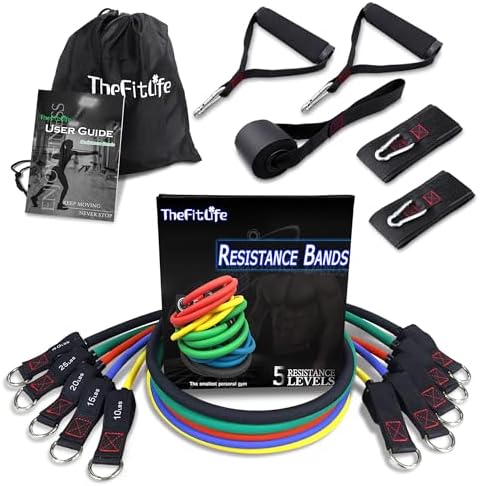
- Start Working Out Without Feeling Overwhelmed:Designed for beginners, women, and rehab training, this set helps you buil…
- Train with Confidence, Not Fear of Snapping:Reinforced connections and tested resistance help reduce snapping risks ofte…
- Stronger Where Most Bands Fail:Upgraded stitching, thicker webbing, and enlarged connection points improve durability in…
Matching Bands to Movement Categories
The World Health Organization advises muscle-strengthening activity that involves all major muscle groups on at least two days per week for adults (Bull et al., 2020). Bands can cover those groups by changing the direction of the pull. The table groups common band movements by body region. The exercise names are illustrative examples of what each band type is commonly paired with, not a prescribed routine. Sets, repetitions, intensity and frequency are deliberately left out because they depend on the individual.
| Body region | Example movements | Band types often used |
|---|---|---|
| Legs and glutes | Squat variations, glute bridge variations, lateral steps | Loop, fabric hip, tube |
| Back and pulling muscles | Seated or standing rows, pull-aparts | Tube with handles, flat, long loop |
| Chest, shoulders and arms | Chest press, overhead press, curls, triceps extensions | Tube with handles, flat |
| Core | Anti-rotation holds, standing pulls | Tube with handles, flat |
Illustrative examples only. A physician or licensed physical therapist can advise which movements and levels suit a specific person.
Safety, Care and Common Questions
Bands store energy, so a slipped anchor or a worn section can release it suddenly. Manufacturers publish inspection and replacement guidance for their own products, and that guidance should take priority over any general article. People with joint problems, cardiovascular conditions, pregnancy, recent surgery or osteoporosis in particular should get professional clearance and supervision before starting. Any exercise that causes pain, dizziness or unusual symptoms should stop, and medical care should be sought if symptoms persist.
Frequently asked questions
Can resistance bands replace dumbbells?
For strength, a meta-analysis found no superiority of weight machines and dumbbells over elastic devices for upper- or lower-limb strength, although the included participants were habitual strength trainers (Lopes et al., 2019). Heavier loads showed an advantage for one-repetition-maximum strength in a separate review (Schoenfeld et al., 2017). Whether bands alone are enough depends on the person’s goals and should be discussed with a professional.
Are the colors the same across brands?
No. The color order is only a convention within a product line, and even within Thera-Band, measured tension differed from the manufacturer’s published values for several colors (Uchida et al., 2016). Comparing the listed force and stretch length is more reliable than comparing colors.
How often should bands be used?
The WHO guideline calls for muscle-strengthening activity on at least two days per week for adults (Bull et al., 2020). It does not prescribe a band-specific routine, so the right frequency and intensity for a given person should come from a qualified professional.
Are bands useful for mobility work?
Bands are often used by trainers and therapists for warm-ups and mobility drills, but the studies reviewed in this article measured strength outcomes and band tension, not mobility (Lopes et al., 2019; Uchida et al., 2016). The strength findings should not be read as evidence for flexibility benefits.
Bottom Line
Resistance bands are a space-saving, low-cost way to meet the WHO’s call for regular muscle-strengthening activity (Bull et al., 2020). The best evidence available suggests elastic resistance produces strength gains comparable to conventional devices in people who already train (Lopes et al., 2019), and light loads can support muscle growth when sets approach failure (Schoenfeld et al., 2017). The practical choice comes down to band type, a resistance range that can grow with the user, and trustworthy force information, since color codes alone are unreliable (Uchida et al., 2016). Before starting any program, a conversation with a physician or physical therapist is the safest first step.
Ready to compare current listings? Check the latest prices and reviews for graded band sets.
Check resistance band setsCompare Resistance Bands by Goal: Strength, Mobility and Convenience
Pick a goal below. The table highlights the matching column and fades the band types that fit that goal less well. The fit ratings are an editorial assessment based on how each band type is built and commonly used, not trial data, so they work as a starting point for a conversation with a physician or physical therapist rather than a prescription.
All five band families are shown. Select a goal to see which ones fit it best.
Strength: tube bands with handles and long loop bands offer the widest resistance range. The strongest evidence reviewed here comes from tube and Thera-Band training, which produced strength gains similar to conventional devices in people who already trained (Lopes et al., 2019). Heavier loads showed an edge for maximal strength (Schoenfeld et al., 2017).
Mobility: flat bands are the most common choice for controlled, assisted movements. The studies reviewed for this article measured strength and band tension, not flexibility or range of motion, so these ratings reflect common practice only. Anyone with a joint problem or injury should get professional guidance first.
Convenient home use: loop, flat and fabric hip bands need no anchor point and fit in a drawer. Tube and long loop bands need a secure door or post anchor, which makes setup slower.
| Band type | Strength | Mobility | Convenience | Main trade-off |
|---|---|---|---|---|
| Loop (mini) | Medium | Medium | High | Can roll or snap against skin; limited for pulling movements |
| Tube with handles | High | Low | Medium | Needs a sturdy anchor; clips and tubing need regular checks |
| Flat (therapy) | Medium | High | High | No handles; open ends are harder to grip and secure |
| Fabric hip band | Medium | Low | High | Fewer resistance levels; not built for overhead pulling |
| Long loop (power) | High | Medium | Low | Highest force, so anchoring mistakes carry more risk |
Dots show the editorial fit rating (three dots = best fit). Strength comment sources: Lopes et al. (2019); Schoenfeld et al. (2017). Individual needs vary.