RECOVERY • MOBILITY • FITNESS
Foam rollers and massage guns are two of the most popular tools used in post-workout recovery routines. Both can be used to target muscles after training, but they work in different ways and may suit different situations.
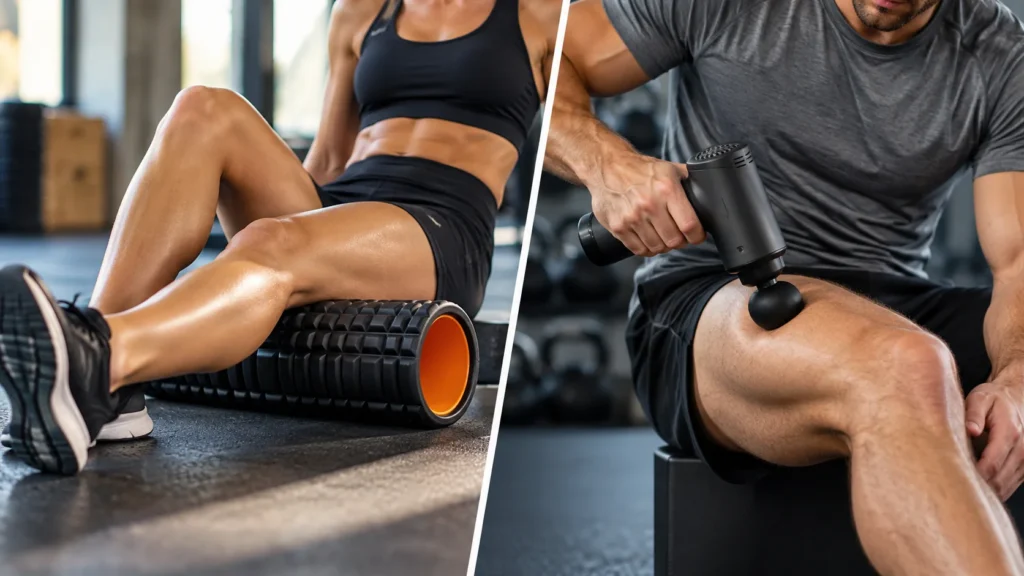
A foam roller uses body weight and broad pressure across larger muscle groups, while a massage gun delivers rapid percussive pressure to more targeted areas. Understanding those differences can make it easier to choose the tool that fits your training style, recovery routine and budget.
This guide compares foam rollers vs massage guns based on how they are used, portability, control, cost and the type of recovery experience they provide.
THE BASICS
What Is the Main Difference Between a Foam Roller and a Massage Gun?
The biggest difference is how pressure is applied. Foam rolling generally involves placing part of the body against a cylindrical roller and using body weight to move across the surface. This creates broad pressure over the muscle being targeted.
A massage gun, also known as a percussion massager, uses a motorized attachment that repeatedly moves against the body. Instead of rolling across a large area, the user can position the device over a more specific location and adjust the pressure or speed depending on the device.
Both tools are commonly used around workouts, but their different designs create noticeably different user experiences.
SIDE-BY-SIDE
Foam Roller vs Massage Gun: Quick Comparison
The table below summarizes some of the practical differences between the two types of recovery tools.
| Feature | Foam Roller | Massage Gun |
|---|---|---|
| Pressure Style | Broad compression | Targeted percussion |
| User Effort | Requires body positioning and movement | Handheld and motorized |
| Coverage | Well suited to larger muscle areas | Useful for more targeted areas |
| Intensity Control | Controlled mainly through body weight | Often includes multiple speed or intensity settings |
| Portability | Lightweight but can be bulky | Compact models are available, but require power or charging |
| Noise | Essentially silent | Motor produces some noise |
| Power Required | No | Yes |
| Typical Cost | Generally lower | Generally higher |

FOAM ROLLING
How Does a Foam Roller Work?
A foam roller is a cylindrical tool made from foam or a combination of foam and a rigid inner core. The user positions a muscle group over the roller and gradually moves across it while controlling pressure through body positioning.
Foam rollers come in different densities, textures and sizes. A softer roller may feel more approachable for beginners, while firmer or textured models can create a more intense sensation.
Because no batteries or charging are required, foam rollers are also relatively simple pieces of equipment to keep at home or take to a gym.


FOAM ROLLER
When Does a Foam Roller Make Sense?
A foam roller is a simple recovery and mobility tool that allows the user to apply pressure across relatively large muscle areas. Because pressure is controlled primarily through body weight and positioning, the experience can range from gentle to fairly intense.
Foam rolling is commonly incorporated into warm-up, cool-down and mobility routines. It does not require electricity, charging or complicated settings, which makes it particularly easy to keep available at home or in a gym.
Potential Advantages
- Generally less expensive than a massage gun.
- No batteries, charging or electricity required.
- Useful for applying pressure across larger muscle areas.
- Pressure can be adjusted by changing body position and the amount of body weight placed on the roller.
- Available in multiple sizes, densities and surface textures.
- Can be incorporated into general mobility routines.
Things to Consider
- Requires more body positioning and physical effort.
- Some areas of the body can be difficult to reach effectively.
- A full-size roller can take up more space in a gym bag.
- Very firm or textured rollers may feel too intense for some users.
- Pressure is less precisely targeted than with a handheld device.
MASSAGE GUN
How Does a Massage Gun Work?
A massage gun is a handheld powered device that uses rapid repetitive movement, often described as percussion, to apply pressure to a targeted area.
Most models include multiple speed or intensity settings, and many provide interchangeable attachments designed for different contact areas or sensations.
Because the device provides the movement, using a massage gun typically requires less body positioning than foam rolling. The user can move the attachment across a muscle and control the amount of pressure applied with the hand.
Potential Advantages
- Allows more targeted application to specific muscle areas.
- Many models offer adjustable speed or intensity levels.
- Requires less body positioning than traditional foam rolling.
- Interchangeable attachments may provide different contact experiences.
- Compact models can be convenient for travel or gym use.
Things to Consider
- Usually costs more than a basic foam roller.
- Requires charging or another power source.
- The motor produces noise during operation.
- Battery life varies between devices.
- Applying excessive pressure may be uncomfortable.
BY USE CASE
Foam Roller vs Massage Gun: Which Fits Different Situations?
Rather than asking which tool is universally better, it is more useful to consider the situation in which the tool will be used.
Larger Muscle Areas
A foam roller provides broad contact and can be convenient when working across areas such as the quadriceps, hamstrings, glutes and calves.
Consider: Foam Roller
More Targeted Pressure
A massage gun allows the user to position a smaller attachment over a more specific area and adjust how much pressure is applied.
Consider: Massage Gun
Lower-Cost Setup
Basic foam rollers are generally simpler devices and often have a lower purchase price than powered percussion massagers.
Consider: Foam Roller
Less Body Positioning
Because the massage gun creates the movement, it may be more convenient for users who do not want to position their body over a roller.
Consider: Massage Gun
Quiet Recovery Routine
A foam roller has no motor and can be used without the operating noise associated with powered recovery devices.
Consider: Foam Roller
Adjustable Settings
Many massage guns provide multiple speed settings and attachments, giving users more options for customizing the experience.
Consider: Massage Gun
HOW TO CHOOSE
5 Questions to Ask Before Choosing
Before buying either recovery tool, consider how it will actually fit into your routine.
How much do you want to spend?
If budget is a major consideration, a foam roller is typically the simpler entry point. Massage guns vary considerably in price depending on power, battery, attachments and other features.
Do you prefer broad or targeted pressure?
Foam rollers naturally cover a wider area, while massage guns make it easier to focus on a smaller location.
Where will you use it?
Consider whether the tool will remain at home, travel to the gym or go with you on trips. Size, weight and the need for charging can matter.
How much physical effort do you want to use?
Foam rolling requires the user to support and reposition the body. A massage gun performs the repetitive movement for you.
Do you want adjustable settings?
If adjustable speeds and interchangeable attachments matter to you, a massage gun offers features that a traditional foam roller does not.
ANOTHER OPTION
Can You Use Both?
The choice does not necessarily have to be one or the other. Some people keep both tools available and use them for different purposes.
For example, a foam roller may be used for broader mobility work, while a massage gun may be used when more targeted application is preferred.
The most useful tool is ultimately the one that fits your routine and that you are comfortable using consistently.
NEXT
What Should You Look for When Buying?
Beyond choosing between a foam roller and massage gun, individual products vary considerably in construction, features and price. The next section explains the specifications worth comparing before purchasing either tool.


Affiliate Disclosure: This website contains affiliate links. We may earn a commission when you purchase products through links on our site, at no additional cost to you. As an Amazon Associate I earn from qualifying purchases.
Learn moreBUYING GUIDE
What Should You Look for Before Buying?
Once you decide which type of recovery tool better fits your routine, the next step is comparing individual products. Foam rollers and massage guns can vary considerably in construction, features, portability and price.
Rather than choosing based only on appearance or marketing claims, consider the features that will affect how you actually use the product.
FOAM ROLLER FEATURES
What to Look for in a Foam Roller
Density
Softer rollers generally provide a gentler experience, while firmer rollers create more noticeable pressure. Consider your comfort level and experience with foam rolling.
Surface Texture
Some rollers have a smooth surface, while others use ridges, grooves or textured patterns. Texture changes how the roller contacts the body.
Length
Longer rollers provide more surface area and may be useful for a wider range of exercises. Shorter rollers are usually easier to store and transport.
Construction
Consider the quality of the foam, the internal structure and whether the roller is designed to maintain its shape with repeated use.
Portability
If you plan to take the roller to a gym or while traveling, diameter, length and overall weight become more important.
Price
A more expensive roller is not automatically the right choice. Compare construction and features with how often you expect to use it.

FOAM ROLLER TO CONSIDER
TriggerPoint GRID Foam Roller
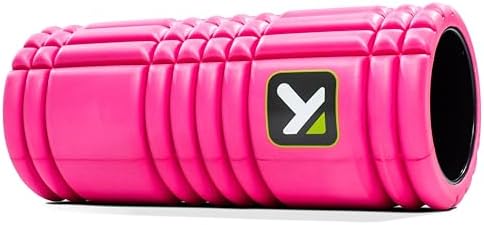
The TriggerPoint GRID is a compact textured foam roller with a rigid hollow core. Its relatively portable size makes it an example of the type of roller that can work for both home and gym use.
- Textured foam surface
- Rigid hollow-core construction
- Compact design
- No charging or power required
Price and availability may change. Check the retailer for current information.
MASSAGE GUN FEATURES
What to Look for in a Massage Gun
Speed Settings
Multiple speed settings allow the user to adjust how quickly the attachment moves and customize the experience.
Attachments
Massage guns often include several attachment shapes. Consider whether the included options are useful for how you expect to use the device.
Battery Life
A cordless massage gun depends on its battery. Consider rated runtime, charging method and how frequently you expect to use the device away from a charger.
Weight & Ergonomics
Because a massage gun is handheld, device weight, handle shape and balance can affect comfort during longer sessions.
Noise
Motor noise varies between devices. A quieter model may be preferable if you plan to use it while watching TV, traveling or sharing a space with others.
Warranty & Support
Because massage guns contain motors, batteries and electronics, warranty coverage and manufacturer support may be worth considering alongside price.
DECISION GUIDE
Which Recovery Tool Fits Your Routine?
Use this summary as a starting point rather than a strict rule. Personal preference, comfort and intended use still matter.
| If You Prioritize… | Consider Starting With |
|---|---|
| Lower initial cost | Foam Roller |
| Broad pressure across larger areas | Foam Roller |
| No batteries or charging | Foam Roller |
| A silent recovery tool | Foam Roller |
| More targeted application | Massage Gun |
| Multiple speed settings | Massage Gun |
| Less body positioning | Massage Gun |
| Interchangeable attachments | Massage Gun |
FREQUENTLY ASKED QUESTIONS
Foam Roller vs Massage Gun FAQ
Is a massage gun better than a foam roller?
Not necessarily. The tools apply pressure differently. A foam roller may be more convenient for broad pressure and mobility work, while a massage gun may be preferable when targeted application and adjustable settings are important.
Can a foam roller and massage gun be used in the same routine?
Some people use both because the tools provide different experiences. For example, a foam roller may be used across larger muscle groups while a massage gun may be used more selectively. There is no requirement to own both.
Which option is more affordable?
Basic foam rollers generally cost less than powered massage guns. Prices vary substantially by brand, construction and features, so current retailer prices should be compared before purchasing.
Which is easier to travel with?
That depends on the model. Short foam rollers can be lightweight but relatively bulky. Compact massage guns may take up less space but add weight and require charging.
Do massage guns need to be charged?
Cordless massage guns use rechargeable batteries and therefore need periodic charging. Battery capacity and runtime vary by model.
Does a foam roller require electricity?
No. A traditional foam roller is a non-powered piece of equipment and does not require batteries or charging.
FINAL TAKEAWAY
Foam Roller or Massage Gun?
The decision comes down to how you prefer to approach your recovery routine.
A foam roller offers a simple, non-powered way to apply broad pressure and incorporate mobility work. It is generally affordable, quiet and easy to maintain.
A massage gun provides a more targeted, motorized experience with adjustable settings on many models. It can require less body positioning but typically costs more and needs to be charged.
Neither tool needs to replace the other, and neither is automatically the right choice for every person. Consider your budget, preferred pressure style, portability needs and how realistically the tool will fit into your routine.
REFERENCES & FURTHER READING
Sources
For evidence-based information about exercise, recovery and physical activity, readers can consult resources from established sports medicine and public health organizations.
- American College of Sports Medicine (ACSM). Exercise and fitness resources.
- National Center for Complementary and Integrative Health (NCCIH). Information on complementary health approaches.
- U.S. Department of Health and Human Services. Physical Activity Guidelines for Americans.
This article is for general informational purposes and does not provide individualized medical advice.