
SPORTS SCIENCE • RUNNING • FOAM ROLLING
Foam rolling after running is a popular recovery practice among recreational and competitive runners. Scientific research has examined its potential effects on muscle soreness, range of motion, and physical performance. However, the evidence suggests that its benefits vary according to the outcome measured and the methods used (Wiewelhove et al., 2019; Wilke et al., 2020).
Researchers have studied foam rolling in relation to range of motion, muscle soreness and athletic performance. The findings are useful, but they are more nuanced than simply saying that foam rolling “speeds recovery.”
This article examines what research currently tells us about foam rolling after running and, equally importantly, what the available evidence does not establish.

QUICK ANSWER
Foam Rolling After Running: What Does Research Show?
To an extent — but the results depend on what outcome is being measured.
Research suggests that foam rolling can influence range of motion and may reduce perceived muscle soreness after exercise in some circumstances.
However, research does not establish foam rolling as a guaranteed method for accelerating recovery, preventing injuries or improving every measure of athletic performance.
EVIDENCE AT A GLANCE
What Researchers Have Studied
Range of Motion
Systematic reviews and meta-analyses have found short-term increases in joint range of motion following foam rolling compared with no intervention.
Muscle Soreness
Post-exercise studies suggest foam rolling may reduce perceived muscle soreness in some settings, although protocols and effect sizes vary.
Performance
Effects on measures such as strength, sprinting and jumping are generally smaller and are not consistently beneficial across every outcome.
Long-Term Effects
Researchers have also investigated repeated foam-rolling training. Some studies report improvements in range of motion, but questions remain about protocols and how findings apply across populations.
THE BIGGER PICTURE
What Did a 2019 Meta-Analysis Find?
A meta-analysis published by Wiewelhove and colleagues in Frontiers in Physiology analyzed 21 studies examining foam rolling before and after exercise.
The researchers reported small effects for several outcomes. Post-rolling slightly attenuated some exercise-related decreases in sprint and strength performance and reduced perceived muscle pain.
However, the authors characterized the overall effects of foam rolling on performance and recovery as relatively minor and partly negligible.
The evidence is more consistent with foam rolling being an optional tool that may influence certain outcomes than with the idea that it is a universal or powerful recovery intervention.
RESEARCH SPOTLIGHT
One Experiment: MacDonald et al. (2014)
One frequently cited experiment was conducted by Graham Z. MacDonald, Duane C. Button, Eric J. Drinkwater and David G. Behm and published in 2014 in Medicine & Science in Sports & Exercise.
What Did the Researchers Do?
The study included 20 men with at least three years of resistance-training experience.
Participants completed a demanding exercise protocol involving 10 sets of 10 back squats. They were randomly assigned to a foam-rolling condition or a control condition.
The foam-rolling group performed a 20-minute protocol immediately after exercise and again at 24 and 48 hours. Researchers monitored outcomes including muscle soreness, range of motion and physical performance during the following 72 hours.
RESULTS
What Did They Observe?
The foam-rolling condition was associated with less reported muscle soreness and differences in several measures of range of motion and subsequent performance compared with the control condition.
The study therefore provides experimental evidence that foam rolling can influence some responses following intense exercise.
The participants were resistance-trained men completing a high-volume squat protocol. They were not runners being studied after a running session.
For that reason, these findings should not be presented as proof that a runner will experience the same effects after a run.
MacDonald GZ, Button DC, Drinkwater EJ, Behm DG. Foam Rolling as a Recovery Tool after an Intense Bout of Physical Activity. Medicine & Science in Sports & Exercise. 2014;46(1):131–142. doi:10.1249/MSS.0b013e3182a123db.
FOR RUNNERS
What Does This Mean for Runners?
The distinction between evidence from exercise studies and evidence specifically involving runners matters. Research conducted after resistance exercise can help us understand possible effects of foam rolling, but it cannot automatically establish identical effects after running.
For runners, foam rolling is better viewed as an optional technique whose potential effects should be considered alongside the limitations of the available research.
Looking for instructions rather than the research?
Read: How to Use a Foam Roller After Running →NEXT
Soreness, Range of Motion and Performance
Next, we examine these outcomes separately and look at what systematic reviews and meta-analyses tell us about each one.

- Foam
- PATENTED MULTI-DENSITY SURFACE REPLICATES A MASSAGE THERAPIST’S HANDS: Three distinct foam zones, wide and flat like the…
- RIGID HOLLOW CORE WRAPPED IN EVA FOAM FOR LASTING FIRMNESS: Unlike solid foam rollers that compress and lose shape over …
Affiliate Disclosure: This website contains affiliate links. We may earn a commission when you purchase products through links on our site, at no additional cost to you. As an Amazon Associate I earn from qualifying purchases.
Learn moreMUSCLE SORENESS
Does Foam Rolling Reduce Post-Exercise Soreness?
Muscle soreness is one of the main reasons athletes use foam rollers after training, and it is also one of the outcomes researchers have investigated.
The 2019 meta-analysis by Wiewelhove and colleagues found that post-rolling reduced the perception of muscle pain across the studies included in that analysis.
There is evidence that foam rolling may influence how sore someone feels after exercise. That is different from demonstrating that foam rolling repairs muscle damage faster or guarantees faster physiological recovery.
RANGE OF MOTION
What About Flexibility and Range of Motion?
Range of motion is one of the outcomes for which foam rolling has relatively consistent research support.
A systematic review and multilevel meta-analysis by Wilke and colleagues included 26 trials and found a positive acute effect of foam rolling on joint range of motion compared with no exercise.
However, foam rolling was not superior to stretching in that analysis.
These are different outcomes and should not be treated as interchangeable.
PERFORMANCE
Does Foam Rolling Improve Athletic Performance?
The evidence is less compelling when the question changes from mobility or soreness to performance.
In the Wiewelhove meta-analysis, pre-rolling produced small improvements in sprint performance and flexibility, while effects on jumping and strength were negligible.
Post-rolling slightly attenuated some exercise-related reductions in sprint and strength performance, but the overall effects were modest.
LONGER-TERM RESEARCH
What Happens When Foam Rolling Is Used Repeatedly?
Research has also examined foam rolling performed over several weeks rather than as a single session.
A 2022 systematic review and meta-analysis found a moderate overall effect of foam-rolling training on range of motion compared with control conditions. However, the authors also reported substantial heterogeneity and differences according to muscle group and intervention duration.
The effect observed in one joint or muscle group should not automatically be assumed to occur everywhere in the body or under every foam-rolling protocol.
WHY RESULTS VARY
Not Every Foam Rolling Study Tests the Same Thing
Foam-rolling research varies substantially in how the intervention is performed.
RUNNING CONTEXT
Can These Findings Be Applied Directly to Runners?
Cautiously.
Some general findings about foam rolling may be relevant to physically active adults, but studies using resistance exercise or mixed athletic populations are not automatically running-specific evidence.
A runner should therefore distinguish between a study showing an effect after exercise in general and a study specifically testing runners after a running session.
NEXT
What Should You Look for in a Foam Roller?
The final section connects the research with product selection, explains what features actually differ between rollers and provides the scientific references used throughout this article.


Affiliate Disclosure: This website contains affiliate links. We may earn a commission when you purchase products through links on our site, at no additional cost to you. As an Amazon Associate I earn from qualifying purchases.
Learn moreFOAM ROLLER FEATURES
What Actually Differs Between Foam Rollers?
The research does not establish one foam roller as universally superior. When comparing products, practical differences include density, texture, dimensions, construction and portability.
Changes how firm the roller feels under body weight.
Can range from a uniform smooth surface to ridged or patterned designs.
Affects portability and the amount of surface area available.
Some rollers are solid foam; others use foam around a rigid core.

TEXTURED DESIGN
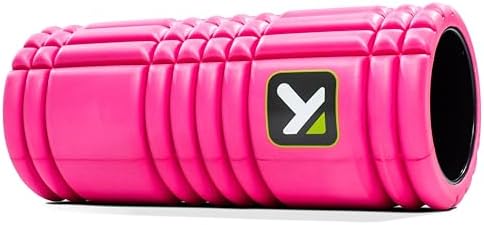
TriggerPoint GRID Foam Roller
The GRID combines a textured foam exterior with a rigid hollow core. Its relatively compact format makes it different from longer traditional foam rollers.
- Textured surface
- Rigid hollow core
- Compact format
- No power or charging required

SMOOTH DESIGN
High-Density Smooth Foam Roller
A smooth roller provides a more uniform contact surface and is available in several lengths and densities.
- Smooth surface
- Multiple sizes available
- Simple construction
- No batteries required
FAQ
Foam Rolling After Running: Common Questions
Does foam rolling reduce muscle soreness?
Some post-exercise research has reported reductions in perceived muscle soreness. However, this should not be interpreted as proof that foam rolling accelerates tissue healing or physiological recovery in every person.
Does foam rolling increase range of motion?
Systematic reviews and meta-analyses have found acute improvements in range of motion compared with no intervention. Research also indicates that responses can vary according to protocol and muscle group.
Does every runner need to foam roll?
No. The available research does not establish foam rolling as a requirement for every runner or after every running session.
How long should a runner foam roll?
Studies use different durations and protocols. An experimental protocol should not automatically be converted into a universal recommendation for runners.
Can foam rolling prevent running injuries?
The research discussed here does not establish foam rolling as a proven method for preventing running injuries.
Where can I learn how to use a foam roller?
For practical positioning and technique, see How to Use a Foam Roller After Running .
BOTTOM LINE
What Does the Evidence Actually Tell Us?
Foam rolling is widely used in sport, and research supports measurable effects on some outcomes — particularly range of motion and, in some post-exercise studies, perceived soreness.
The effects on athletic performance and broader recovery outcomes are generally smaller and less consistent. Evidence from resistance-training studies should also not automatically be treated as running-specific evidence.
For runners, the most defensible conclusion is therefore not that foam rolling is essential, but that it is an optional tool with some evidence-supported effects and important limitations.
SCIENTIFIC REFERENCES
Research Cited
- MacDonald GZ, Button DC, Drinkwater EJ, Behm DG. Foam Rolling as a Recovery Tool after an Intense Bout of Physical Activity. Medicine & Science in Sports & Exercise. 2014;46(1):131–142. doi:10.1249/MSS.0b013e3182a123db.
- Wiewelhove T, Döweling A, Schneider C, et al. A Meta-Analysis of the Effects of Foam Rolling on Performance and Recovery. Frontiers in Physiology. 2019;10:376. doi:10.3389/fphys.2019.00376.
- Wilke J, Müller AL, Giesche F, Power G, Ahmedi H, Behm DG. Acute Effects of Foam Rolling on Range of Motion in Healthy Adults: A Systematic Review with Multilevel Meta-analysis. Sports Medicine. 2020;50(2):387–402.
- Skinner B, Moss R, Hammond L. A Systematic Review and Meta-Analysis of the Effects of Foam Rolling on Range of Motion, Recovery and Markers of Athletic Performance. 2020.
- Konrad A, Nakamura M, Tilp M, Donti O, Behm DG. Foam Rolling Training Effects on Range of Motion: A Systematic Review and Meta-Analysis. Sports Medicine. 2022;52(10):2523–2535. doi:10.1007/s40279-022-01699-8.