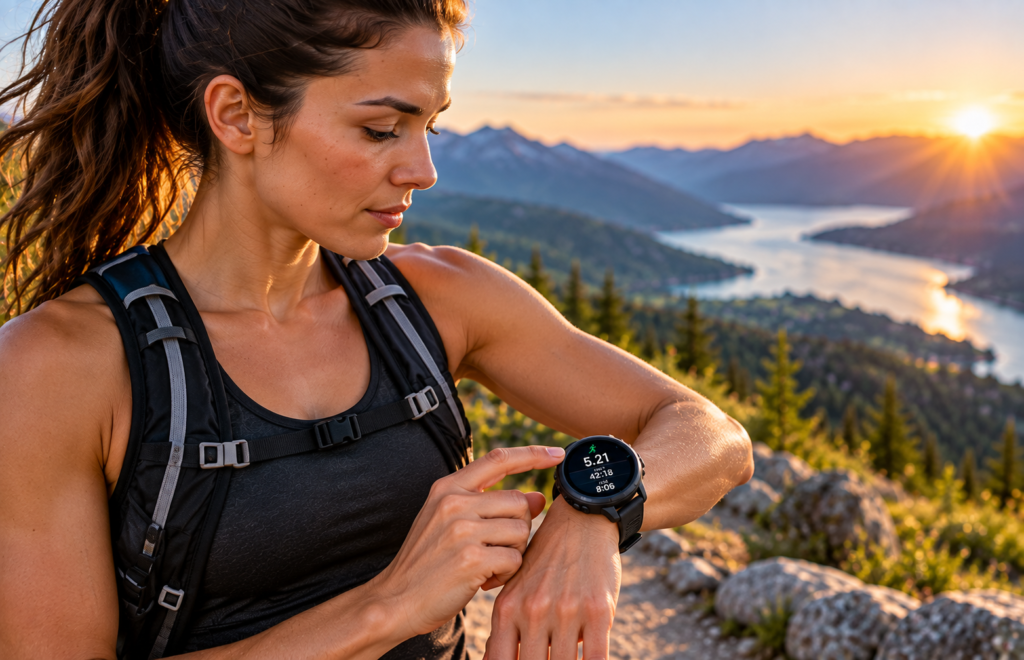
What to look for in a GPS running watch depends on a runner’s training goals, preferred routes and the data they want to track. Important features include GPS accuracy, battery life, heart rate tracking, navigation, comfort and training tools. Understanding these features can make it easier to choose a GPS running watch that matches the runner’s actual needs.
What to Look for in a GPS Running Watch First
A running watch should first perform the functions that matter during running. For many athletes, that means recording distance, pace and time without creating unnecessary complexity.
However, current GPS running watches can offer much more. Depending on the model, features can include wrist-based heart rate, multi-band positioning, training status, recovery estimates, courses, maps, music and multisport tracking.
For example, Garmin’s current running-watch range distinguishes between entry-level, advanced and premium devices and offers different combinations of training, mapping, connectivity, positioning and battery features. Therefore, more expensive does not automatically mean more appropriate for every runner.
What to Look for in a GPS Running Watch: GPS Accuracy
GPS capability is one of the first considerations when evaluating a running watch because location data are used to calculate metrics such as route, distance and pace.
Nevertheless, runners should not assume that every GPS watch will produce perfectly identical measurements. Gilgen-Ammann et al. (2020) evaluated eight positioning-enabled sports watches under different outdoor conditions. The researchers found that measurement error varied according to device and environment, with urban and forest conditions generally creating greater challenges than track environments.
Multi-GNSS and Multi-Band Positioning
Some newer watches can communicate with multiple satellite navigation systems, while selected models also support multi-band positioning. These capabilities can be useful when satellite signals are difficult to receive or reflect from surrounding structures.
However, the presence of advanced positioning technology should still be weighed against price, battery consumption and the environments in which the runner actually trains.
2. Battery Life in a GPS Running Watch
Battery specifications deserve particular attention because manufacturers usually report different figures for smartwatch mode and GPS activity modes. Therefore, a headline battery figure does not necessarily indicate how long the watch will record a run with GPS active.
For short recreational runs, battery endurance may rarely become a limiting factor. In contrast, marathon training, trail running, ultramarathons or multi-day activities can make GPS-mode battery life substantially more important.
Product specifications and battery claims should always be verified against the manufacturer’s current documentation because models and software features change over time.

- Make a bold statement with this rugged GPS smartwatch, featuring a vibrant 1.2” AMOLED display and up to 18 days of batt…
- Engineered with a supertough 45 mm fiber-reinforced polymer case and metal-reinforced bezel
- Built-in LED flashlight with variable intensities and strobe modes gives you greater visibility in the outdoors and prov…
Affiliate Disclosure: This website contains affiliate links. We may earn a commission when you purchase products through links on our site, at no additional cost to you. As an Amazon Associate I earn from qualifying purchases.
Learn moreWhat to Look for in a GPS Running Watch: Heart Rate Tracking
Wrist-based optical heart rate is now common on GPS running watches. It can provide convenient information about heart rate during everyday activity and training without requiring a chest strap.
However, convenience should not be confused with clinical-level precision. A systematic review and meta-analysis by Zhang et al. (2020), which included 44 articles across 15 brands, found generally acceptable validity for wrist-worn heart rate devices during many common activities. Nevertheless, accuracy varied according to the activity.
Similarly, Gillinov et al. (2017) found that accuracy differed among wearable devices and exercise modes. In their study, an electrode-based chest monitor showed the closest agreement with electrocardiography.
4. Training and Recovery Features
Another factor in what to look for in a GPS running watch is how much training analysis the runner actually wants.
Basic watches may focus on time, distance, pace and heart rate. In contrast, more advanced devices can estimate or calculate metrics such as training load, VO2 max., recovery time, training status and suggested workouts.
These metrics can help organize information from previous sessions. Nevertheless, algorithm-generated estimates should be interpreted as tools rather than unquestionable measurements of a runner’s physical condition.
For example, Garmin explicitly describes several of its training-status measurements as estimates and notes that a device may require a period of activity data before learning about the user’s performance.

6. Comfort, Size and Display
A technically advanced watch is of limited value if the runner dislikes wearing it. Case dimensions, weight, strap fit and display visibility should therefore be considered alongside software specifications.
Case Size
Larger cases can provide larger displays and may accommodate larger batteries. However, smaller wrists may find a large sports watch uncomfortable, particularly during sleep tracking or long-distance running.
Display Type
Bright AMOLED displays can provide strong contrast and rich graphics. Meanwhile, other display technologies may emphasize outdoor readability and battery efficiency. The appropriate choice depends on how and where the watch will be used.
GPS Running Watch Features at a Glance
| Feature | Why It Matters | Who May Value It Most |
|---|---|---|
| Built-in GPS | Tracks route, distance and pace | Most outdoor runners |
| Multi-band GNSS | Can improve positioning in challenging environments | Trail and urban runners |
| Long GPS battery life | Supports longer recording sessions | Marathon and ultra runners |
| Wrist heart rate | Convenient effort monitoring | Everyday training |
| External HR sensor support | Allows compatible chest-strap use | Data-focused athletes |
| Navigation/maps | Helps follow routes | Trail and adventure runners |
| Training metrics | Adds analysis of recorded workouts | Structured-training runners |
| Music | Can reduce dependence on a phone | Runners who train with audio |

- Sends accurate real-time heart rate and HRV data to compatible Garmin smartwatches and cycling computers, fitness equipm…
- Comfortable machine-washable strap is available in two sizes (XS–S and M–XL) for the most ideal fit for your body type
- Understand how much you slow down when your foot hits the ground with step speed loss, and improve your running form wit…
Affiliate Disclosure: This website contains affiliate links. We may earn a commission when you purchase products through links on our site, at no additional cost to you. As an Amazon Associate I earn from qualifying purchases.
Learn more7. Decide Which Smart Features Actually Matter
Music storage, notifications, contactless payments and smartphone integration can make a running watch more convenient. However, these functions should not automatically take priority over core running requirements.
For example, a runner who always carries a phone may have little reason to pay more solely for onboard music. Conversely, someone who deliberately runs without a phone may value that feature considerably more.
Therefore, separating “useful” features from “interesting” features can help control the purchase price.
What to Look for in a GPS Running Watch by Runner Type
Beginner Runner
A beginner may primarily need dependable GPS, clear pace and distance information, comfortable fit, straightforward controls and sufficient battery life. Advanced metrics are optional rather than mandatory.
5K and 10K Runner
Interval functionality, pace alerts, heart-rate support and structured workouts may become more useful when training becomes more organized.
Half-Marathon and Marathon Runner
Battery life, reliable GPS recording, workout programming and easy-to-read pace information become particularly relevant during longer training sessions and races.
Trail Runner
Navigation, elevation information, robust construction and longer battery life may deserve greater emphasis. In addition, advanced satellite modes can be useful in environments where positioning is more challenging.
Triathlete
A triathlete may need multisport activity profiles, swimming support, cycling-sensor compatibility and smooth transitions between activities. Therefore, a basic running-only watch may not meet the same requirements.
Common Mistakes When Choosing a GPS Running Watch
Buying More Features Than Needed
A long specification list can be attractive. Nevertheless, unused features do not automatically make a watch more useful.
Comparing Only Smartwatch Battery Life
For runners, GPS-mode battery specifications may be more relevant than the maximum figure advertised for ordinary smartwatch use.
Assuming Every Sensor Is Perfect
GPS distance, optical heart rate and algorithm-derived training metrics all have limitations. Consequently, watch data should be interpreted in context rather than treated as error-free measurements.
Ignoring Fit
A watch may be worn for running, everyday activity and sleep. Therefore, comfort and case dimensions can matter as much as an additional software feature.
Choosing by Brand Alone
Different models from the same manufacturer can target very different users. As a result, model-level specifications should be compared rather than assuming that the brand name alone determines suitability.
Frequently Asked Questions About GPS Running Watches
Do runners need a GPS watch?
No. Running can be performed without a GPS watch. However, a GPS watch can make it easier to record route, distance, pace and other training information without relying entirely on a smartphone.
How accurate are GPS running watches?
Accuracy varies by device, environment and activity. Research comparing positioning-enabled sports watches has found measurable errors, particularly in more challenging urban and forest environments. Therefore, recorded distance should not be assumed to be perfectly exact.
Is wrist heart rate accurate enough for running?
Wrist-based optical heart rate can provide useful information for many runners. However, research demonstrates device- and activity-dependent variation. A compatible chest sensor may be preferable when more precise heart-rate measurement is important.
Is multi-band GPS worth having?
It can be useful for runners who frequently train in challenging satellite environments, such as dense urban areas or trails. However, runners training mostly in open areas should compare the potential benefit against price and battery requirements.
How much battery life does a running watch need?
The answer depends on the intended activity. A runner training for short distances has different requirements from an ultramarathon runner. Therefore, buyers should compare the manufacturer’s stated battery duration for the GPS mode they expect to use.
What to Look for in a GPS Running Watch: Final Checklist
Understanding what to look for in a GPS running watch begins with identifying the runner’s actual needs rather than searching for the device with the greatest number of features.
GPS performance, GPS-mode battery life, comfort and clear running data form a useful foundation. Heart-rate tracking, advanced training metrics, navigation, maps, music and multisport functions can then be evaluated according to the runner’s training style.
Most importantly, wearable measurements have limitations. Therefore, a running watch is best treated as a tool for collecting and organizing training information rather than as an infallible measurement or medical device.
References
Gilgen-Ammann, R., Schweizer, T., & Wyss, T. (2020). Accuracy of distance recordings in eight positioning-enabled sport watches: Instrument validation study. JMIR mHealth and uHealth, 8(6), e17118. https://doi.org/10.2196/17118
Gillinov, S., Etiwy, M., Wang, R., Blackburn, G., Phelan, D., Gillinov, A. M., Houghtaling, P., Javadikasgari, H., & Desai, M. Y. (2017). Variable accuracy of wearable heart rate monitors during aerobic exercise. Medicine & Science in Sports & Exercise, 49(8), 1697–1703. https://pubmed.ncbi.nlm.nih.gov/28709155/
Zhang, Y., Weaver, R. G., Armstrong, B., Burkart, S., Zhang, S., & Beets, M. W. (2020). Validity of wrist-worn photoplethysmography devices to measure heart rate: A systematic review and meta-analysis. Journal of Sports Sciences, 38(17), 2021–2034. https://pubmed.ncbi.nlm.nih.gov/32552580/