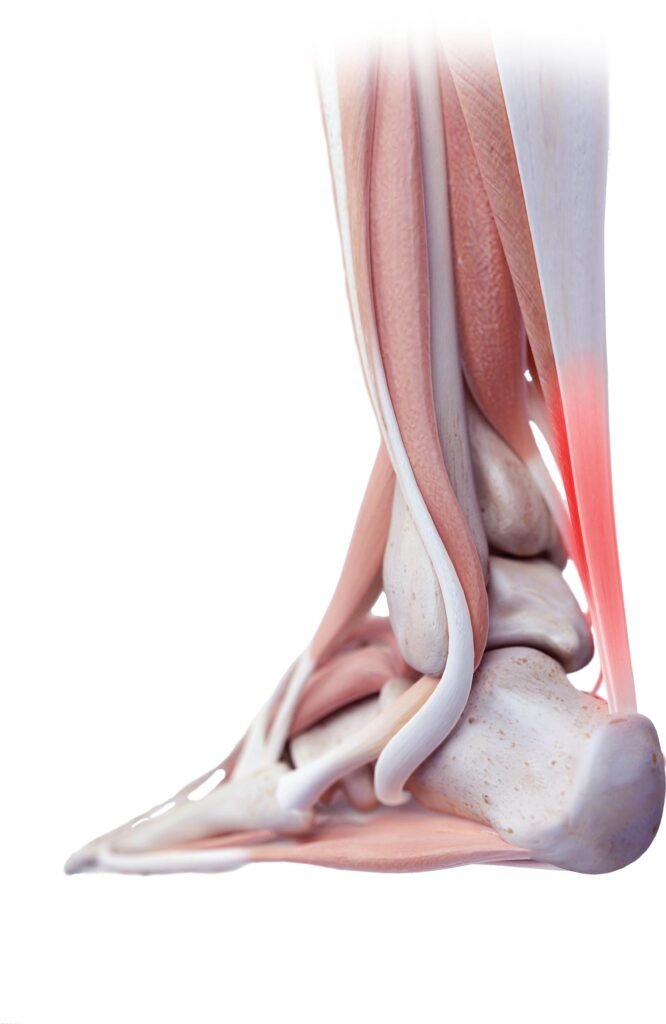
The Achilles tendon is the strongest and one of the most heavily loaded tendons in the human body. Every step taken during walking, running, jumping, or climbing stairs places substantial force on this structure. For runners and other athletes, the tendon may experience loads exceeding six to eight times body weight during high-speed activities, making it particularly vulnerable to overuse injuries.
Among these injuries, Achilles tendinopathy is one of the most common causes of pain in the back of the ankle. It affects everyone from recreational runners beginning a fitness program to elite marathoners, basketball players, soccer players, tennis players, hikers, and CrossFit athletes.
According to the American Academy of Orthopaedic Surgeons (AAOS), Achilles tendinopathy develops gradually when repetitive loading exceeds the tendon’s capacity to repair itself. Rather than resulting from a single traumatic event, it usually develops over weeks or months as microscopic damage accumulates within the tendon.
The American Orthopaedic Foot & Ankle Society (AOFAS) similarly describes Achilles tendinopathy as an overuse condition influenced by multiple factors, including sudden increases in physical activity, calf muscle tightness, inadequate recovery, and biomechanical abnormalities.
Research published in the Journal of Orthopaedic & Sports Physical Therapy (JOSPT) estimates that Achilles tendon disorders account for 6% to 18% of all running-related injuries, while lifetime prevalence may reach nearly 50% among endurance runners.
Fortunately, sports medicine research also shows that many cases are preventable. Progressive training, proper load management, strength training, flexibility, recovery, and appropriate footwear all contribute to maintaining tendon health.
This guide explains:
- What Achilles tendinopathy is
- The anatomy of the Achilles tendon
- Why athletes develop tendon pain
- Early warning signs
- Different types of Achilles tendinopathy
- Scientific evidence regarding prevention
- The role of strength training and biomechanics
- Recovery strategies supported by research
- Equipment that may assist runners
- Frequently asked questions
Medical Disclaimer: This article is intended for educational purposes only. Persistent Achilles pain should always be evaluated by a qualified healthcare professional, such as a sports medicine physician or physical therapist.
- What Is Achilles Tendinopathy?
- Why the Achilles Tendon Is So Important for Athletes
- How the Achilles Tendon Works During Running
- Tendon Adaptation: Why Loading Is Necessary
- Achilles Tendinopathy vs. Achilles Tendonitis
- Types of Achilles Tendinopathy
- Why Athletes Develop Achilles Tendinopathy
- Risk Factors Supported by Scientific Evidence
- Early Signs and Symptoms
What Is Achilles Tendinopathy?
Achilles tendinopathy is a chronic overuse condition affecting the Achilles tendon, the thick fibrous structure connecting the calf muscles to the heel bone (calcaneus).
The tendon transmits force generated by the gastrocnemius and soleus muscles, allowing movements such as:
- Walking
- Running
- Sprinting
- Jumping
- Climbing stairs
- Rising onto the toes
According to the Mayo Clinic, Achilles tendinopathy develops when repetitive mechanical loading produces microscopic damage within tendon fibers faster than the body can repair them.
Historically, many clinicians referred to this condition as Achilles tendonitis, implying inflammation.
However, research over the past two decades has demonstrated that most chronic cases involve degenerative changes rather than ongoing inflammation.
Because of this, organizations including the British Journal of Sports Medicine (BJSM) and numerous tendon researchers now prefer the term Achilles tendinopathy, which encompasses structural tendon changes, pain, and impaired function without assuming inflammation is always present.

Understanding the Achilles Tendon Anatomy
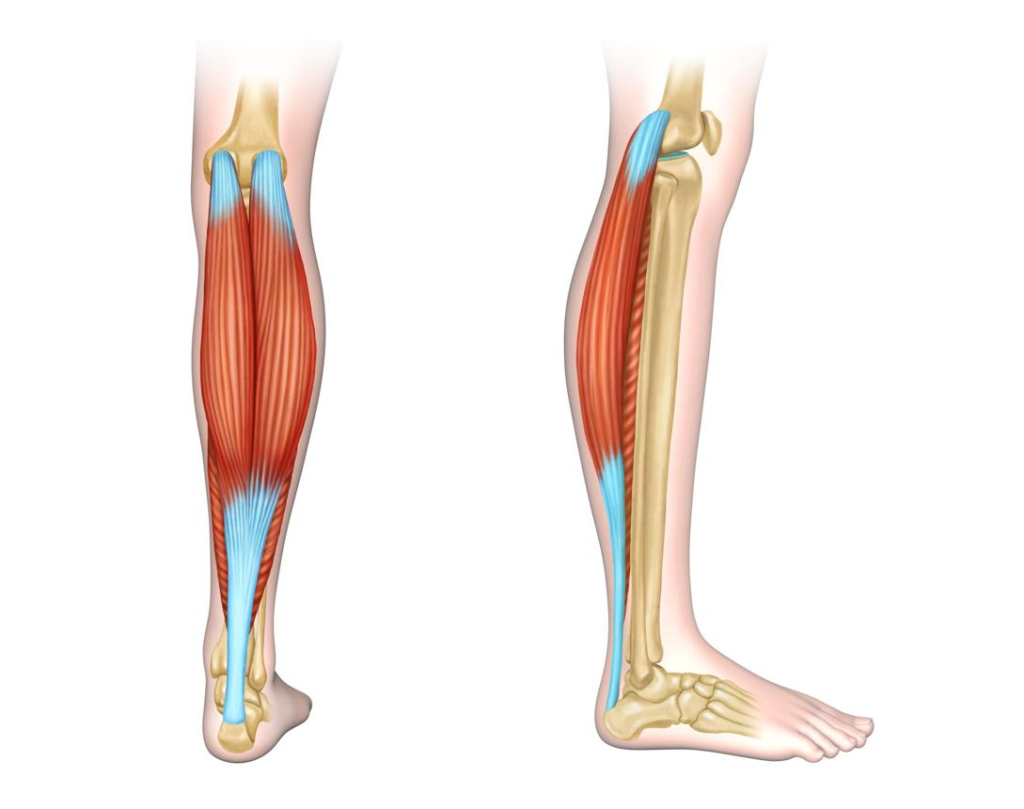
The Achilles tendon is the largest and strongest tendon in the human body.
It forms where two major calf muscles merge:
- Gastrocnemius
- Soleus
These muscles join together several inches above the ankle to create the Achilles tendon, which inserts into the back of the heel bone (calcaneus).
Its primary functions include:
- Storing elastic energy
- Producing forward propulsion
- Absorbing impact forces
- Controlling ankle motion during landing
- Improving running efficiency
During running, the Achilles tendon behaves much like a spring. It stretches when the foot contacts the ground, storing mechanical energy, and then releases that energy during push-off, making movement more efficient.
According to the American College of Sports Medicine (ACSM), this elastic energy storage significantly reduces the metabolic cost of running.
Why the Achilles Tendon Is So Important for Athletes
Athletes rely heavily on the Achilles tendon during nearly every lower-body movement.
Each running stride requires rapid transfer of force between the calf muscles and the foot.
Research has shown that the tendon may experience forces ranging from:
- 3–5 times body weight during walking.
- 6–8 times body weight during running.
- Even greater forces during sprinting and jumping.
Because these loads occur thousands of times during a typical training session, even small biomechanical abnormalities or training errors may gradually overload the tendon.
How the Achilles Tendon Works During Running
The running gait cycle consists of several phases:
- Initial contact
- Midstance
- Heel rise
- Toe-off
- Swing phase
During these movements, the Achilles tendon repeatedly stretches and recoils.
According to the Journal of Biomechanics, this stretch-shortening cycle allows the tendon to function like a biological spring, reducing muscular energy expenditure.
When training loads remain within the tendon’s adaptive capacity, collagen fibers become stronger over time.
When loading exceeds recovery capacity, microscopic degeneration begins to accumulate.

- All-In-One Home Workout System: The Ally Peaks doorway pull up bar set includes the pull up bar, hex key, door anchor, 2…
- 360° Full Door Frame Protection & Anti-Slip Stability:We have pioneered the design by adding silicone pads to all contac…
- Original Quick-Adjust Wide Grip Design:The easily adjustable wide grip width of the pullup bar doorway allows wide, neut…
Tendon Adaptation: Why Loading Is Necessary
Unlike muscles, tendons adapt relatively slowly.
According to the American Physical Therapy Association (APTA), tendons require repeated mechanical loading to stimulate collagen production and improve stiffness.
Completely avoiding tendon loading for prolonged periods may actually reduce tendon capacity.
For this reason, modern rehabilitation programs rarely recommend complete rest unless a tendon rupture or another severe injury is present.
Instead, clinicians often prescribe progressive loading programs, allowing the tendon to adapt safely while minimizing excessive pain.
Achilles Tendinopathy vs. Achilles Tendonitis
Although the terms are frequently used interchangeably, they are not identical.
| Achilles Tendonitis | Achilles Tendinopathy |
|---|---|
| Primarily inflammatory | Primarily degenerative with failed healing response |
| Usually acute | Often chronic |
| May occur after sudden overload | Develops gradually over weeks or months |
| Inflammation predominates | Collagen disorganization predominates |
The British Journal of Sports Medicine recommends using Achilles tendinopathy as the preferred clinical term because it more accurately reflects the pathology observed in most chronic cases.
Types of Achilles Tendinopathy
Clinicians generally classify Achilles tendinopathy into two main categories.
Midportion Achilles Tendinopathy
Approximately 55–65% of cases occur in the middle portion of the tendon, typically 2–6 cm above the heel bone.
Symptoms commonly include:
- Pain during running
- Morning stiffness
- Tenderness when squeezing the tendon
- Thickening of the tendon
This region receives relatively limited blood supply, which may contribute to slower healing.
Insertional Achilles Tendinopathy
Insertional Achilles tendinopathy occurs where the tendon attaches to the calcaneus.
Patients frequently report:
- Pain directly at the heel
- Discomfort while climbing stairs
- Pain during uphill running
- Difficulty wearing shoes with rigid heel counters
According to the AOFAS, insertional tendinopathy may coexist with bone spurs or bursitis in some individuals.
Treatment recommendations often differ slightly from those for midportion tendinopathy because excessive stretching may aggravate insertional symptoms.
Why Athletes Develop Achilles Tendinopathy
Current research recognizes Achilles tendinopathy as a multifactorial injury.
Rather than resulting from one isolated cause, several contributing factors usually interact.
According to the AAOS, common contributors include:
- Rapid increases in training volume
- Sudden increases in running intensity
- Hill running
- Sprint training
- Tight calf muscles
- Limited ankle mobility
- Weak calf muscles
- Poor recovery
- Running on unfamiliar terrain
- Worn-out footwear
The ACSM further emphasizes that inadequate recovery between high-load training sessions may prevent tendon tissue from adapting appropriately.
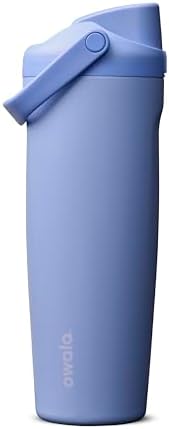
- 30-ounce insulated stainless steel water bottle with extra features: includes a 2-in-1 spout that lets you choose how yo…
- Choose your sip style—straw or swig: Patented 2-in-1 FreeSip spout is one of a kind; it lets you sip upright through the…
- Hygienic push-button lid and easy carry handle: closed lid keeps spout covered and clean between sips; ergonomic bucket …
Risk Factors Supported by Scientific Evidence
1. Sudden Changes in Training Load
One of the strongest predictors of Achilles tendinopathy is increasing training volume or intensity too quickly.
According to the American College of Sports Medicine, tendons adapt more slowly than the cardiovascular system.
This explains why runners often feel capable of increasing mileage before their connective tissues are fully prepared.
Rather than recommending a universal percentage increase, ACSM encourages gradual progression based on:
- Running experience
- Age
- Recovery capacity
- Previous injuries
- Overall workload
2. Previous Achilles Injury
Research consistently identifies previous tendon injury as one of the greatest predictors of future symptoms.
According to systematic reviews published in JOSPT, collagen remodeling may continue long after pain disappears.
Returning to unrestricted training too early may increase recurrence risk.
3. Limited Ankle Dorsiflexion
Restricted ankle mobility alters lower-limb biomechanics.
The American Physical Therapy Association recommends evaluating dorsiflexion range of motion in athletes experiencing Achilles pain.
Limited mobility may increase tendon loading during running.
4. Calf Muscle Weakness
Strong calf muscles reduce the mechanical demand placed on the Achilles tendon.
Weakness or poor muscular endurance may increase tendon strain during repetitive running.
However, researchers published in JOSPT emphasize that calf strength should be evaluated individually rather than assuming weakness is present in every athlete.
5. Age
Although Achilles tendinopathy can occur at any age, the condition becomes more common after approximately 30 years of age.
Age-related changes in tendon collagen, blood supply, and elasticity may reduce the tendon’s capacity to tolerate repetitive loading.
Nevertheless, regular physical activity and progressive strength training continue to improve tendon health throughout adulthood.
Early Signs and Symptoms
Recognizing symptoms early provides the best opportunity to modify training before more significant tendon damage develops.
According to the Mayo Clinic, common symptoms include:
- Pain along the back of the ankle.
- Morning stiffness.
- Tenderness when pressing on the tendon.
- Pain that worsens after running.
- Mild swelling around the tendon.
- Reduced calf strength.
- Difficulty performing heel raises.
In the early stages, discomfort often decreases after warming up. As the condition progresses, pain may persist throughout exercise and even during daily activities.
Ignoring these warning signs may allow the condition to worsen, potentially increasing the time required for recovery.
How Achilles Tendinopathy Affects Athletic Performance
Achilles tendon pain often leads athletes to unconsciously alter their movement patterns. They may shorten their stride, reduce push-off force, or shift weight to the opposite leg to avoid discomfort. Although these compensations can temporarily lessen pain, they may increase stress on the knees, hips, or lower back.
According to the American College of Sports Medicine, continuing high-intensity training despite persistent tendon pain may prolong recovery and contribute to reduced athletic performance over time.

- 24-ounce insulated stainless-steel water bottle with a FreeSip spout and push-button lid with lock
- Patented FreeSip spout designed for either sipping upright through the built-in straw or tilting back to swig from the s…
- Protective push-to-open lid keeps spout clean; convenient carry loop doubles as a lock